

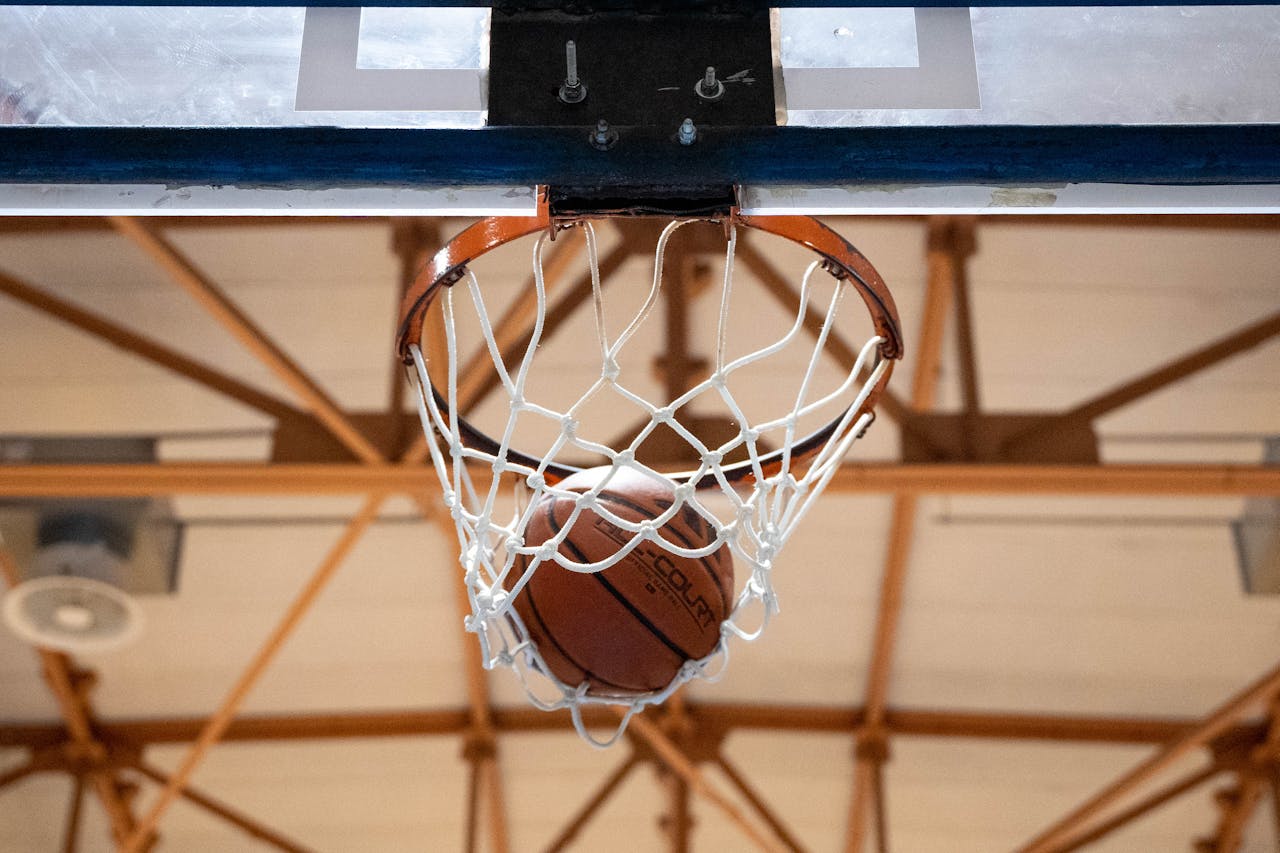
Most players practice wrong. They show up, shoot around for an hour, chase their own rebounds, and call it a workout. Then they wonder why nothing transfers to games.
The drills in this article are built around the principle that reps that feel like the game make you better at the game. Reps that don't, don't.
Stop chasing rebounds and start training the way the game demands.
What Are the Best Basketball Drills for Practice?
The best basketball drills for practice are catch-and-shoot drills, off-the-dribble shooting drills, finishing drills, defensive footwork drills, and conditioning drills that keep your heart rate up while you work on skill.
This is not because those sound good on a list, but because those are the situations you face every single game.
Brandon Payne, who has trained Steph Curry since 2011, runs every drill at game speed with variables built in. Different angles, different pass types, different distances. The logic is, if you only practice straight-line catch-and-shoot from the same spot at the same pace every day, that is the only version of the shot you are training. Games don't give you that shot.
Start with the categories that give you the fastest return based on where your game is weakest. A ball you can't control is a turnover before it's anything else.
Best Shooting Drills for Consistency
Catch-and-Shoot Drill
Stand at one spot. Get a pass, or spin the ball to yourself to simulate one. Catch, set your feet, shoot.
The detail that separates a productive session from a wasted one is footwork on every single rep. One-two into the shot. Quick stab so you spend less time in the air. If you are resetting your feet differently on each catch, you are not building muscle memory.
Do 20 makes from each of five spots. That's 100 makes minimum. If it takes you two hours, that tells you something about where your shot is right now.
Spot Shooting Drill
Five spots: both corners, both wings, top of the key. Shoot from each spot until you hit a set number of makes, then rotate. Track your makes and attempts honestly.
If you are shooting 35% from the left corner and 60% from the right wing, that is telling you where your next hundred reps need to go.
The goal is not just to get shots up but to find out where your shot breaks down and then fix it there.
Around-the-World Shooting
Start at one corner and work around the arc. One make is required before you move to the next spot. No moving on until the ball goes in.
This builds two things: shooting under mild pressure and the endurance to maintain mechanics when your legs are tired. By the time you are on your fourth or fifth spot, your form will want to break down. That is exactly when you need to hold it together.
Best Basketball Drills Using a Shooting Machine
A shooting machine removes chasing your own rebounds. When a player in the Kobe Bryant Mamba Mentality challenge finally got access to a machine, he described it as the most shots he had ever put up in one session.
He also said he was more tired than expected, because moving between spots without stopping is a different kind of cardio than walking to get your own ball.
That is the reason why GRIND was built. The GRIND Machine returns makes and misses automatically across 9 spot positions at up to 1,000 reps per hour. That changes your training math completely, and it's backed by a limited warranty so the investment holds up as long as the work does.
Rapid Fire Catch-and-Shoot
Set the machine to pass continuously. Catch and shoot as fast as you can while keeping your mechanics intact. The moment your mechanics break down, slow down. Speed without form is just practicing bad habits at a faster pace.
Game-Speed Movement Shooting
Catch, shoot, relocate to the next spot before the next pass comes. This is the closest you can get to game conditions alone. You are moving before the ball arrives, catching on the move, and shooting immediately.
Brandon Payne runs Curry through exactly this kind of variability every session because the game never gives you the same shot twice.
Reaction Shooting Drill
Let the machine pass randomly between spots. Your job is to read where the ball is going and get there before it arrives. This builds the anticipation and early recognition that separates players who look slow from players who look like they always have time.
See how the GRIND Machine changes your rep count and your training floor.
Best Solo Basketball Drills
Training alone is where real improvement happens, but it requires more discipline than group training because nobody is pushing you. Kyrie Ibrahim has talked about how imagination in solo sessions is what separates players who develop from players who just get older.
Visualize a defender. Visualize a screen. Make the drill feel like a game situation or you are wasting the rep.
The best solo drills are form shooting close to the basket, one-dribble pull-ups, cone or line movement drills, free throw routines under fatigue, and finishing drills that challenge your body control rather than just your layup technique.
Start every solo session with form shooting two feet from the basket. Single hand release, then guide hand, then full shot. This is the most important drill you will do because every shot starts here.
Coach Paris, who played Division I ball after being cut in sixth grade by ignoring fundamentals, credits this kind of foundational work for everything that came after.
Off-the-Dribble Shooting Drills for Guards
Pull-Up Jumper Drill
Attack from the top of the key with two hard dribbles and pull up. The key detail Brandon Payne emphasizes with Curry is the pickup. Specifically, the moment the ball comes off the floor into the shot pocket.
That pickup should be smooth, straight, and consistent. If it’s clean at the start of a workout, the rest of the session builds on it. If it’s sloppy, everything built on top of it’s sloppy.
Do 10 pull-ups from the top, 10 from each elbow. Focus entirely on the pickup and the footwork gather. The shot will follow.
Change-of-Direction Shooting
Crossover into a pull-up. The crossover should be a hard pound dribble with the ball kept outside the body and close, not loose in front of you where a defender can get it.
Drop your shoulder toward the defender's hip on the change, then take a quick long step into the shot. The shoulder drop is what makes the move quick. Without it, you are just switching hands.
Step-Back Shooting Drill
Drive baseline, create space with a step-back, shoot off balance. The reason you train this is body control in uncomfortable positions is a skill.
Payne has Curry work on shots at odd angles and from limited footwork specifically because the game puts you in those situations and your body needs to know what to do. Make the drill hard enough that you are missing 30 to 40 percent. If you are making everything, the drill is too easy.
Team Shooting Drills
Jokic sees the floor differently from everyone else in the game right now. He can call out his opponents’ plays before they run them and pass to spots where teammates hadn't arrived yet. This is a player who understands how an offense is supposed to move and trains his eyes to read it in real time.
Most players never develop that because their drills don't require them to. Pass-and-relocate is the most underused team drill at every level below college.
One player passes, immediately cuts to a new spot, receives the next pass, shoots. Run this continuously for three minutes. Most youth and high school programs stand and watch after they pass. That is not how the game works.
Transition shooting off a live rebound is the drill that transfers most directly to games. Player shoots, offensive rebounder grabs the miss, outlets to a guard who pushes in transition and pulls up at the elbow or attacks the rim. Do this at full speed. Slow transition drills train slow transition habits.
Drive-and-kick is simple: attack the paint, kick to a shooter in the corner who catches and shoots immediately. No waiting, no extra dribble. The kick should hit the shooter in the shot pocket. If the shooter needs a dribble to get set, the pass was late or the shooter was not ready.
How to Structure a Basketball Practice Session
Kobe Bryant's routine worked because it was consistent in structure even when the content changed. Reading his Bible, watching movies, getting shots up, lifting. He repeated this order over and over. That predictability allowed his body and mind to go deeper into each phase rather than figuring out what came next.
Structure your practice the same way.
Warm up for 10 to 15 minutes with form shooting and light movement. Not stretching in place, actual movement with the ball. Footwork on the line, ball wraps, shadow shooting close to the basket.
Skill work runs 20 to 30 minutes. This is where your shooting drills, ball handling, and individual moves live. Full concentration. No checking your phone between reps.
Game simulation is 20 to 30 minutes. Live drills, 1-on-1, pick-and-roll reads, any drill that requires you to make decisions. This is the piece most solo players skip entirely and it’s the piece that makes the other two transfer.
Conditioning runs 10 to 15 minutes at the end, not the beginning. High-rep shooting at an elevated heart rate, suicides, or movement drills. Your body remembers the last 20 to 30 shots of a workout. Make sure they are high quality and you are holding your mechanics when you are tired.
How Many Reps Per Day in Shooting Practice
Beginners should target 100 to 200 made shots per session. Not attempts, but makes. Intermediates should be at 300 to 500. Advanced players working seriously toward a next level should be at 500 to 1,000 and above.
Curry's workouts with Payne run four to six rounds of consecutive makes at multiple spots, with transition shooting in between, tracked by heart rate monitor. The drill does not end when you feel ready. It ends when you hit the number.
The player in the Kobe challenge needed almost two hours to get 100 makes from five spots on day one. By day seven he scored 14 points against the best team in his league. Volume matters, but only when it’s attached to real mechanics and intentional reps.
Volume matters, but only when it’s attached to real mechanics and intentional reps. If you're not sure where to start, the GRIND FAQ covers the most common setup and training questions.
How Long Should Each Drill Last
Short competitive drills run two to four minutes at maximum intensity. Focused skill drills run five to ten minutes with full concentration. Any drill that goes beyond ten minutes without a clear competitive target attached to it will lose its intensity and stop producing useful reps.
Payne uses consecutive make targets rather than time limits for most of Curry's shooting work. You do not move to the next spot until you hit three in a row, or four in a row, depending on where they are in the offseason.
This keeps intensity high regardless of how many minutes it takes. If you add a time limit to a drill, players pace themselves to fill the time. If you add a make target, they push until it’s done.
Drills That Simulate Real Game Situations
The most game-like drill you can run alone is catch-and-shoot with a side step or movement trigger before the catch. You are not standing still waiting for the ball in a game, but coming off a screen, relocating after a drive, or stepping into a passing lane.
Payne designs Curry's workouts around receiving a pass while a defender is applying physical pressure, then creating space and getting a clean shot off. You can simulate this with a resistance band, a partner, or simply by requiring yourself to move into every catch rather than standing still for it.
Full-court transition shooting with a sprint to half court before every pull-up is the drill that transfers most directly to late-game fatigue situations. If you can make pull-up jumpers at 80 percent heart rate in practice, the same shot at 60 percent heart rate in a game feels automatic.
The principle is aim small, miss small. Pick a specific spot on the rim based on your angle, not the rim as a whole. A shooter who is targeting a one-inch spot on the back of the rim will miss smaller than one who is aiming at an 18-inch circle.
Finishing Drills to Complement Shooting
Most finishing drills are too easy because there is no defense. Focus on practicing how to finish when your body is off-balance, your timing is disrupted, or someone is in your path.
Challenge your body control by limiting your footwork. Do finishes with one step only. Do finishes where you gather with your non-dominant foot. Try reverse layups from both sides until they feel as natural as standard ones. Do eyes-closed finishing drives where you open your eyes as late as possible and have to find the rim mid-air.
A player who can only finish in straight lines is easy to defend. A player who can adjust mid-air and still put the ball in the rim from an awkward position is not.
What Drills Improve Shooting the Fastest
High-repetition catch-and-shoot with movement built in improves the fastest. The reason is variability. Introducing slight changes in angle, distance, or approach on every rep forces your motor system to learn the shot more deeply than repeating the exact same movement over and over.
If you can only shoot 40 percent on stationary catch-and-shoot, work block style until you can. Repeat the same shot, same spot, and build the basic pattern. Then start adding variability once the foundation is solid. If you are already a reliable stationary shooter, staying stationary in practice is making you worse relative to what games require.
A shooting machine speeds this up faster than anything else because it removes the time lost to rebounding and lets you run continuous moving drills at high rep counts without breaking the session to retrieve the ball.
Browse the full GRIND lineup and find the right setup for your training environment.
Our Verdict
Most players need fewer drills done at higher intensity with better structure. Pick three or four from this list that target your weakest areas, build them into a consistent daily routine, and track your makes honestly.
Kobe trained the same structure every day for 20 years. Curry still works on the pickup at the start of every offseason session because the smallest details at the foundation determine everything built on top of them. Jokic cannot guard most wings one on one and he knows it. What he built instead is an understanding of how offenses move that lets him be in the right place before the ball gets there.
The work does not get easier. You get better at doing it.
Start building your routine around equipment that keeps up with it.
FAQ
What are the best basketball drills for practice?
The best basketball drills prioritize catch-and-shoot reps, off-the-dribble pull-ups, and finishing with body control challenges. You must also include defensive footwork and transition shooting at game speed to ensure your skills translate to a competitive environment.
What drills improve shooting the fastest?
High-rep catch-and-shoot drills with movement variability improve shooting the fastest because they force your body to adjust to different angles and speeds. While shooting from the same spot builds a single repetition, movement-based drills teach you to make shots from anywhere on the floor under any condition.
What are good solo basketball drills?
Effective solo drills include form shooting close to the basket, one-dribble pull-ups, and step-back shooting. You should also practice finishing with limited footwork and play free throw games while under physical fatigue to simulate end-of-game pressure.
How do I structure a practice session?
Structure your practice by starting with movement and form shooting warm-ups, followed by skill work at full concentration. Transition into game simulations that require rapid decision-making, and finish with conditioning drills when your body is tired to build mental and physical toughness.
How long should each drill last?
High-intensity competitive drills should last two to four minutes, while focused skill work requires five to ten minutes. It is more effective to use make-targets rather than time limits to ensure the intensity remains honest and the quality of reps stays high.
What drills simulate real game situations?
Game-simulated drills are any activities that require you to move before the catch, make a decision under defensive pressure, or shoot with an elevated heart rate. Static shooting is purely for form; game-speed movement and reaction are what translate to the scoreboard.
How many reps should I get up per day?
Beginners should aim for 100 to 200 makes, while intermediate players should target 300 to 500. Advanced athletes should strive for 500 to over 1,000 makes daily. You must always count your makes rather than your attempts to hold yourself to a professional standard of accuracy.
Share:
Best Basketball Shooting Machine: Complete Comparison Guide for 2026
What Is a Basketball Shooting Machine? How It Works and Why It Improves Your Game