

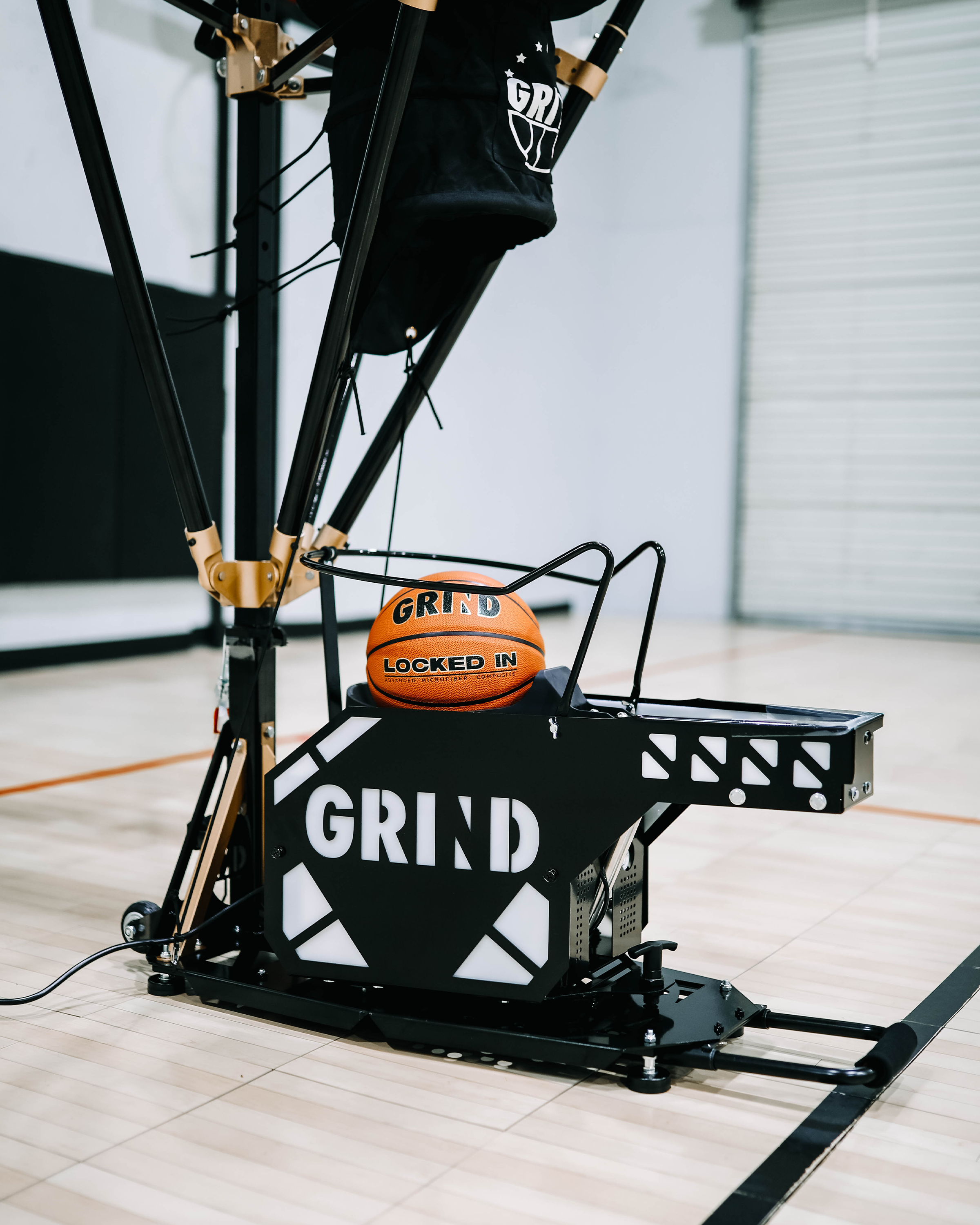
A basketball shooting machine is a training device that catches your shots and passes the ball back to you automatically, so you can keep shooting without chasing rebounds. That single function changes the math of a solo workout completely.
Instead of spending half your session walking after misses, you are shooting. Players who use them regularly report getting up 500 shots in an hour. Without one, that same 500 shots takes closer to six hours alone.
See how the GRIND Machine eliminates dead time and transforms your solo workouts.
What Is a Basketball Shooting Machine?
A basketball shooting machine is a net-and-pass system that sits under your hoop, collects the ball after every shot whether you make it or miss it, and returns it to you at a set interval and location. You set up, load your balls, program where you want the pass, and shoot continuously until you hit your rep target.
The core purpose is to eliminate the dead time between shots. It’s a simple technology with a net, a return mechanism, and a pass system. What separates a $200 DIY build from a $2,000 commercial machine is consistency, durability, and the precision of the pass.
How Does a Basketball Shooting Machine Work?
A basketball shooting machine has a rebounding net that catches every shot, a return mechanism that funnels the ball toward the pass system, and a programmable pass system that delivers the ball to a set spot at a set interval. The net catches the ball, the machine returns it, you shoot again.
Rebounding System
The net sits under and around the rim and catches the ball after every shot. Made or missed, the ball drops into the net and funnels toward the return mechanism. The design of this funnel matters more than most buyers realise.
On the GRIND Machine, the ball is meant to hit the rail before dropping into the arm. If it lands directly on the arm with full momentum, it bounces back out. That one adjustment, the back bungee pulling the funnel into the correct angle, is the difference between a clean catch every time and a ball bouncing across the gym.
The 12 ft net is the wider safety zone. It reaches high and wide to grab any missed shots or wild rebounds that don't go straight into the funnel. Because the net is so tall, it also acts as a visual guide that forces you to shoot with a higher arc so you don't hit the mesh.
The Gun's net also goes up to 12 feet 9 inches on the 10K, which catches hard rim misses that a lower net would miss entirely. Coach Lovett, who runs The Gun in his program, notes that the high net trains players to shoot properly because the net is in the way if they do not.
Passing System
The machine passes the ball back to a programmed spot at a programmed interval. Pneumatic systems like the Grind use air pressure to deliver the pass. Mechanical arm systems like The Gun use a soft-touch throwing arm to pass with backspin, which lands the ball in the same shot pocket every time. The IC3 uses a manual gravity ramp, which is simpler but means the ball rolls back to you rather than being passed.
The time delay between passes is adjustable on programmable machines. Coach Lovett starts players at eight to ten seconds between passes when they are learning, then works the interval down to two seconds as their shot prep improves. Two seconds is close to game speed. If you cannot get your shot off in two seconds from catch to release, you are too slow.
Programmable Settings
On basic machines, you set the pass location manually and rotate between spots yourself. On advanced machines like The Gun 10K and 14X Smart Pass, you program spot sequences, reps per location, pass type, and timing through a touchscreen or drag-and-drop interface. The machine moves through your drill automatically. You shoot.
What Are the Main Benefits of a Shooting Machine?
The primary benefit of a shooting machine is the massive increase in rep volume, allowing you to get up more shots in an hour than you could in a day of traditional practice. It provides a perfectly consistent pass every time, which is essential for building muscle memory, and removes the logistical headache of needing a partner or rebounder to get a high-intensity workout in.
The first benefit is volume. Getting 500 shots up in an hour instead of six means you can run that workout every day rather than once a week. That is no small difference. That is the difference between 500 reps and 3,500 reps in a week from the same time investment.
The second benefit is consistency of the pass. In a game you rarely get the ball the same way twice, but to build the muscle memory of a shot, you need thousands of reps where the catch, the footwork, and the release are as close to identical as possible. A machine delivers the ball to the same spot, at the same height, with the same spin on every pass. That is something a human rebounder cannot reliably do.
The third benefit is solo training. You do not need to find a partner, schedule a trainer, or wait for someone to show up. You go when you go.
A machine makes working on the pickup possible to work on that specific detail a thousand times in a single workout without anyone else in the building.
Can a Shooting Machine Be Used for Solo Practice?
Yes, a shooting machine is designed for solo practice. That is the primary use case for every home and portable machine on the market. Players often describe their first session with a shooting machine as the most shots he had ever put up at one time. They were also more tired than expected, because moving between spots continuously without stopping to retrieve the ball is harder cardio than walking after your own rebounds.
That tiredness is the point. Moving between spots at game speed, catching and shooting without resetting, is what transfers to games. A machine makes it possible to sustain that intensity for an entire session.
What Features Should You Look for in a Shooting Machine?
The five features that matter are net catch reliability, shot output per hour, programmable drills, analytics capability, and portability. Which of those matters most depends entirely on whether you are buying for one player at home or a program running multiple players every day.
Rebounding Net
The net needs to catch made and missed shots reliably. Height matters. A net that sits at rim level only catches clean shots. A net that extends above the rim catches the hard misses that would otherwise roll across the gym floor. Check whether the net is adjustable and how it attaches to the rim and backboard. A back brace or tether that pushes the net toward the rim is what keeps it stable during use.
Shot Output
Measured in reps per hour. The IC3 delivers up to 800 shots per hour with two balls. The GRIND Machine delivers 1,000. The Gun series goes up to 1,800. Higher output matters more if you are running a team through workouts than if you are training solo. One player can only shoot so fast.
Programmable Drills
For solo home use, manual spot rotation is fine. For a team or a structured individual program, you want a machine that programs spot sequences, rep counts, and time intervals so the drill runs without stopping to adjust. The Gun's touchscreen programs in a single touch. The 14X Smart Pass adds drag-and-drop drill building with live heatmaps.
Analytics and Tracking
The Gun series tracks makes and misses and gives you a shooting percentage at the end of each drill. The sensor needs to face outward to read shots correctly — if it gets dusty or foggy it misreads, so keep it clean. Dr. Dish Home adds app-based shot tracking, drill libraries, and video. The IC3 does not have built-in analytics. Know which product you are buying.
Portability
For home use, this determines whether you use the machine or leave it in a corner after the first week. The GRIND Machine folds to 38" x 13" x 18" and weighs 110 lbs. Setup and teardown is 90 seconds. The IC3 weighs 35 lbs and is the most portable option in the comparison. The Gun is a facility machine. It rolls through a standard doorway but it’s not being loaded into a car for a park session.
How Much Does a Basketball Shooting Machine Cost?
Prices range from $499.99 for an entry-level rebound trainer to $1,995 for a full portable shooting machine, with program and facility machines priced on request. What you pay for is pass precision, rep output, and durability under daily use.
The Dr. Dish IC3 is $499.99. It’s a manual rebound-and-return trainer, not a full automated shooting machine. For a player who just needs the ball returned faster than chasing it themselves, it does that job at the lowest price point in this category.
The GRIND Machine is $1,995 on sale, $2,495 regular, and comes backed by a limited warranty built to match the durability of the machine itself. It’s a full pneumatic shooting machine with 9 spot passing, 1,000 reps per hour, and 90-second setup. That is the price point for a serious individual training machine built for home and portable use.
The Gun and Dr. Dish Home are quote-based. Neither lists a public price. If you are a program or facility, contact them directly. Expect program-level investment.
Is a Basketball Shooting Machine Worth It?
If you train alone and you train often, yes. The machine replaces the cost and logistics of finding a rebounder or scheduling a trainer for every session, and it never cancels on you. Whether it earns back its cost fast depends entirely on how often you use it.
The real case for it is that certain skills cannot be built without high repetition of the same movement. Shooting is one of them.
Steph Curry's trainer still works on the pickup at the start of every session after 16 years because consistency at the foundation is what everything else is built on. A machine is what lets you build that foundation alone, at volume, every single day.
Which Brands Are Most Popular?
The three most widely used basketball shooting machine brands are GRIND Basketball, Dr. Dish, and The Gun by Shoot-Away. Each targets a different buyer.
GRIND Basketball is built around the home player. Portable, pneumatic, 9 spot positions, $1,995. Founded by Thomas Fields, who built the company around the player who could not afford or access a $6,000 facility machine. It’s the most portable full shooting machine currently available.
Dr. Dish makes two distinct products that buyers frequently confuse. The IC3 is a $499.99 manual rebound trainer. Dr. Dish Home is a higher-end automated machine with app integration, drill libraries, and shot tracking. Do not buy the IC3 expecting the features of Dr. Dish Home.
The Gun by Shoot-Away is the standard for programs and facilities. All 30 NBA teams, 99% of Division I colleges, and over 20,000 high schools use it. The 10K is what most programs run. The 14X Smart Pass is the current flagship with Smart Pass technology, automatic pass-distance adjustment, live heatmaps, and setup in under 30 seconds.
What Is the Best Shooting Machine?
The best basketball shooting machine depends on where you train and how many players are using it.
For home use, GRIND Basketball. The portability, setup time, and price point are built specifically for the player training alone without a dedicated facility.
For programs and schools, The Gun. The adoption numbers exist because it runs reliably under heavy daily use, programs fast, and passes consistently. The 14X Smart Pass is the right conversation if your facility wants the full analytics layer.
For players who want data integrated into their training, Dr. Dish Home. App-based drill tracking, shot percentages, video. If your coaching staff will actually use it, it earns its price.
For the lowest entry point, the IC3 at $499.99. It returns the ball. That is what it does, and for some players that is enough.
Browse the full GRIND lineup to find the right machine for your setup.
Where Are Shooting Machines Used?
Shooting machines are used in home courts, school and college gyms, NBA and professional facilities, and basketball training camps. The right machine for each setting is different.
Home courts and driveways are where portable machines like the GRIND and IC3 see the most use. A player training before school or after work does not need a facility. They need a machine that sets up fast and stores small.
School and college gyms run The Gun because it handles multiple players through structured workouts without breaking down. Coach Lovett notes that his players will get 250 shots up in 20 minutes when a machine is available. Without one, the same players will find reasons not to shoot after practice.
NBA and high-major facilities run the full Shoot-Away lineup. Curry's workout with Brandon Payne uses machine-assisted drilling as part of a session that tracks heart rate, consecutive make streaks, and transition shooting at a pace most players could not sustain for five minutes.
Basketball camps and training facilities use machines as the centerpiece of individual skill stations. One machine running continuously through a rotation of players is more efficient than three coaches rebounding manually.
Why Shooting Machines Improve Performance
Shooting machines improve performance because they remove the obstacles that prevent high-rep practice. Simply put, you shoot more.
More shots with correct mechanics, at game speed, to a consistent target, build the muscle memory that shows up in games. The machine does not make you a better shooter by itself. It removes the obstacles that prevent you from putting in the reps that make you better.
Every great shooter in the game took more shots than the players around them. A machine is how you close that gap when you are training alone.
Stop waiting on a rebounder and start getting up the shots that make you better.
FAQ
What is a basketball shooting machine?
A basketball shooting machine is a training device that uses a high-rimmed net to capture made and missed shots, funneling the balls into a motorized passing system. It automatically returns the ball to the shooter at preset intervals and locations, allowing for continuous, high-repetition practice without the need for a human rebounder.
How does a shooting machine work?
A shooting machine operates by using a collapsible netting system to catch the ball and gravity to feed it into a launch mechanism. Most commercial units use either a mechanical arm or a pneumatic firing pin to pass the ball back to the player at adjustable speeds, distances, and angles across the court.
Is a shooting machine worth it?
A shooting machine is worth the investment for any athlete or program training at least three times per week. It eliminates the logistical burden of finding a rebounder and can increase a player's shot volume by 300% to 500% compared to a traditional solo workout, directly accelerating muscle memory and shooting consistency.
Which brands are most popular?
As of 2026, the most popular brands are GRIND Basketball for portable home use and Shoot-Away (The Gun) for professional and school programs. Dr. Dish is the industry leader for tech-integrated training with app-based analytics, while Airborne (IC3) remains the top choice for entry-level manual rebounders.
Can it be used for solo practice?
Solo practice is the primary purpose of a shooting machine. It allows a single player to perform game-speed drills, such as catch-and-shoot or baseline-to-wing movement, without needing a partner. In other words, it’s effectively acting as an automated coach and rebounder that never tires.
What features should I look for?
You should prioritize net height and catch reliability to ensure misses are consistently captured. Essential technical features include a passing rate of at least 1,000 reps per hour, programmable court spots for multi-position drills, and, if training at home, a compact storage footprint with a setup time under two minutes.
How much does a basketball shooting machine cost?
Pricing for shooting machines in 2026 follows three distinct tiers. The manual IC3 rebounder costs approximately $499, while the motorized GRIND Basketball machine is $1,995 on sale ($2,495 regular). Professional-grade units like the Dr. Dish Home or The Gun typically start around $2,995 and can exceed $10,000 for institutional models with advanced team analytics.
Share:
Best Basketball Drills for Practice: Improve Shooting, Consistency, and Game Performance
Basketball Rebounder Guide: Stop Chasing the Ball and Start Shooting